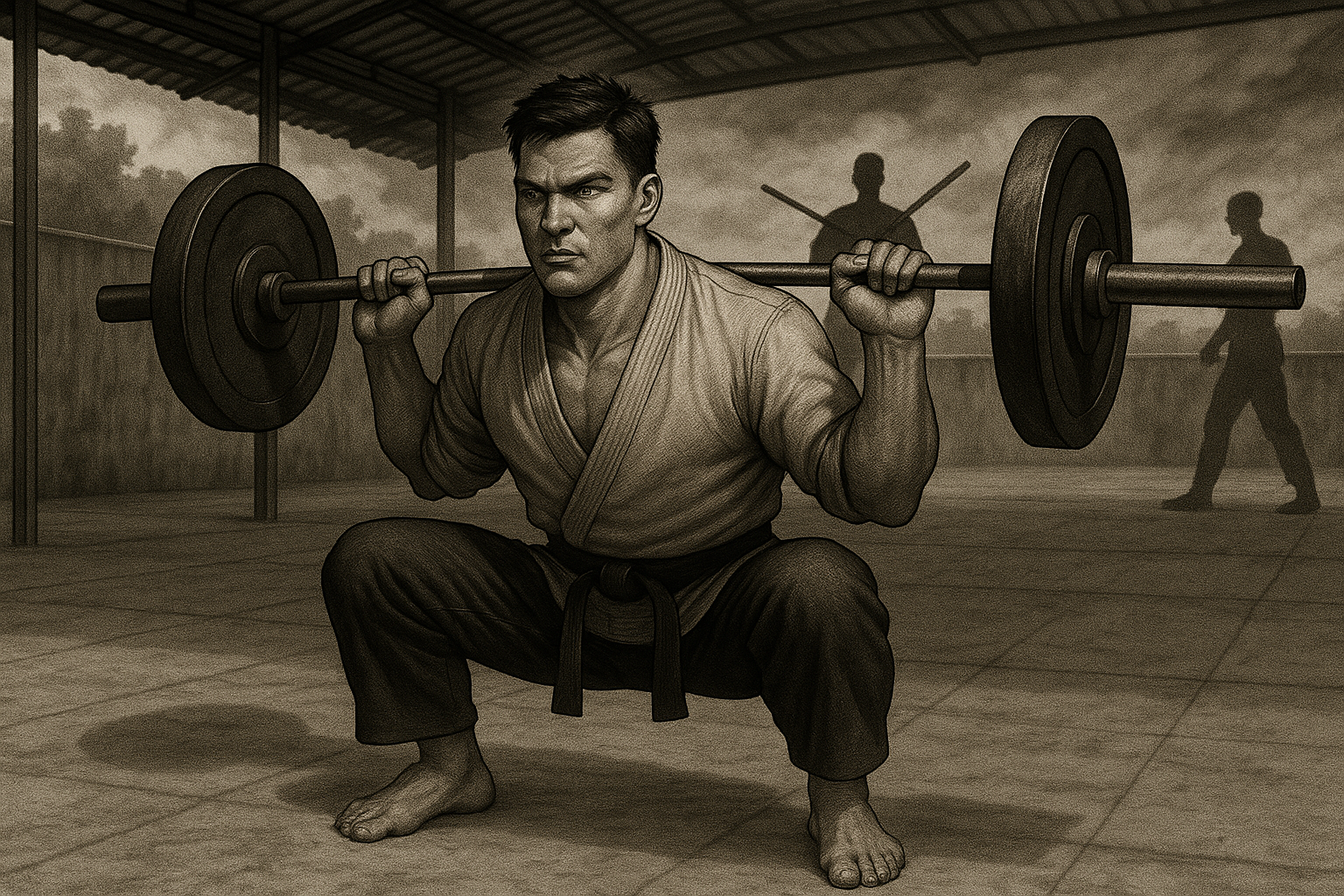
It still amazes me that in some corners of the martial arts world, people are still saying that lifting weights will make you bulky—and therefore slow.
Even more bizarre? These same folks will also claim:
“Weight training takes too long to work.”
But also, “Just looking at a barbell will make you blow up like Arnold.”
Let’s be clear: that’s nonsense. Unless you’re eating and training like a competitive bodybuilder, you’re not going to “accidentally” get huge.
And even if you could? Being stronger makes you better at martial arts. Period.
You Don’t Need to Train for Hours
If you’re spending more than 60 minutes, three times a week on resistance training, it’s probably more than you need. Efficient programming and consistency beat volume every time—especially if you’re cross-training with martial arts.
Injury Prevention Starts With Strength
I used to think that flexibility alone would protect me from injury.
So, I stretched all the time.
But I also avoided strength training because I believed it would make me stiff and slow.
And yet… I kept getting injured. Weird injuries. Like the time I threw my back out catching a 4-pound medicine ball. Why? Because I had no muscular support for my range of motion.
Flexibility without strength is a liability.
– Author
Real, functional mobility comes from strong, supported joints. Resistance training teaches your muscles how to engage, not just stretch. That improves:
Energy efficiency
Coordination
Joint stability
Injury resistance
Stronger = More Useful
Let’s keep it simple: strong people are more useful—to themselves, their families, their training partners.
If you’re stronger, you’re probably:
Healthier
More mobile
More durable
Less stressed
And when it comes to martial arts? Strength amplifies everything:
You hit harder
You move faster
You absorb impact better
“Strong people are just more useful—to themselves and to others.”
– Author
Where’s the downside?
How Strength Is Built (and Why Reps Aren’t Enough)
All strength gains follow the same basic formula:
Stress → Recovery → Adaptation
If you’re detrained, anything makes you stronger—even walking or doing bodyweight exercises. That’s why beginners make fast progress.
But once your body adapts to those inputs, progress stalls. You’ll hear people say:
“You just need to do more reps.”
That works—for a while. But if you want to go further, you need to be specific. You need real resistance.
The Big Four: The Foundation of Strength
“If you want to get better at martial arts, you need more than just reps. You need resistance.”
– Author
Once you’ve moved past basic calisthenics, it’s time to add compound lifts. Start with:
Low-Bar Back Squat
Deadlift
Bench Press
Overhead Press
These lifts train your body as a system. They engage multiple muscle groups, force full-body coordination, and build resilience like nothing else.
The Art of Manliness – YouTube playlist covering the Big 4 lifts and a couple extra.
A Simple Plan:
Learn correct form (get a coach or reputable guide)
Warm up properly
Lift progressively heavier weights over time
Rest at least 48 hours between lifting sessions
Yes, you’ll be sore at first. Stick with it—your body adapts quickly.
Training for Your Art
Once you’ve got a base of strength, shift your focus to specificity.
That means:
Keep lifting 2–3x per week
Add mobility work on off days
Drill footwork under light resistance
Use isometrics to strengthen martial movement patterns
Strong muscles only help if they support strong technique. Build both.
Voluntary Hardship is a Superpower
Strength training is uncomfortable. So is martial arts. So is growth.
But leaning into discomfort builds mental calluses. It trains you to:
Push past resistance
Delay gratification
Stay calm under pressure
That’s not just good for fighting. That’s good for life.
This is the same discomfort that helped humans build civilizations. It’s a superpower most people never develop.
Don’t run from discomfort—train it.
“Voluntary hardship is a superpower—and strength training is how you train it.”
– Author
Final Thoughts
Lifting weights won’t make you bulky. It won’t make you slow. It won’t hurt your martial arts—it will enhance them.
With strength comes:
Resilience
Speed
Power
Confidence
That’s not a distraction from martial training. That’s the foundation of it.
When the blades were banned, the sticks came out. This post explores how Filipino martial arts survived Spanish colonization by adapting into dance, theater, and backyard stick drills.
Once a self-defense claim is allowed in court, the prosecution only needs to disprove one of the Five Elements to dismantle your case. This post breaks down how each element—Innocence, Imminence, Avoidance, Proportionality, and Reasonableness—can be attacked in court, and what you can do to prepare.
What are martial arts really about—beyond kicks, punches, and ancient scrolls? This post breaks down how martial arts function as skill-building systems for performing under pressure, drawing parallels to military training, stress management, and personal growth. Spoiler: repetition is the secret sauce.
You’ve trained for years, mastered your forms, and weathered countless drills—yet real violence doesn’t come with a replay button. Believing martial arts makes you invincible sets you up for a rude awakening. In this post, we unpack why even the most seasoned practitioner can be caught off guard, and how to train for real-world resilience.
Before the Spanish brought steel and sermons, the islands were already in motion—raids, rivalries, and warriors with blades. This post dives into the tribal roots of Filipino Martial Arts.
You’ve probably heard the claim: “Fire-hardened rattan is so strong, it can shatter a steel blade!” It’s a bold statement — and one that sounds awesome if you’re into martial arts legends (lord knows, I’ve made the claim before!).But let’s be clear: that’s a myth. In this post, we’re busting the hype and diving into…